


Before switching from Dragon Medical One to Sunoh.ai, compare the full Dragon path.
Keep provider control. Reduce review burden. Capture better audio. Upgrade to Microsoft AI on your terms.
A fast draft is only valuable if the note is accurate, clinically useful, and easy for the provider to finalize. Review the complete documentation workflow before replacing a process your clinicians already know.
- Renew Dragon Medical One
- Evaluate Sunoh.ai before switching
- Protect provider control
- Upgrade to Microsoft Dragon Copilot
- Improve ambient capture
- Evaluate CNEX connector fit
Compare before you switch
Do not assume Sunoh.ai is a simple replacement for Dragon Medical One.
eDist helps eClinicalWorks practices compare workflow, accuracy, review burden, pricing, audio capture, Dragon Copilot planning, CNEX fit, and certified support before providers lose the Dragon workflow they already know.
Before switching from Dragon Medical One to Sunoh.ai, compare workflow fit, review burden, provider control, audio capture, and the Dragon Copilot path.
- Workflow fit: How providers create, edit, and complete documentation.
- Review burden: How much time providers spend checking and correcting drafts.
- Provider control: When and how clinicians control the final note.
- Audio capture: Whether real exam-room conversations are captured clearly.
- Dragon Copilot path: How the practice can move toward Microsoft AI without starting over.
Accuracy, misinterpretation, and review burden
Concerned about Sunoh.ai accuracy, misinterpretations, or AI scribe hallucinations?
If your eClinicalWorks practice is evaluating Sunoh.ai, accuracy should be part of the conversation. Ambient AI scribes can reduce documentation burden, but they also introduce a new responsibility: every AI-generated draft must be reviewed, corrected, and approved before it becomes part of the medical record.
Review burden matters because the final note still belongs to the provider.
Sunoh.ai states that providers must review, edit as needed, and save the generated summary, and that no AI program is perfect. Public user feedback also shows why cleanup time, changed details, and diagnosis or plan accuracy should be tested before replacing Dragon Medical One.
This does not mean every Sunoh.ai experience will be poor. It means practices should validate the tool in real clinical workflows before they change a trusted documentation process.
The clinical context problem
If a patient presents with a new knee injury but the AI-generated note describes it as a long-term knee problem, the issue is not just wording.
The provider now has to catch the mistake, correct the note, verify the assessment, adjust the plan if needed, and make sure the final record accurately reflects the visit.
That creates review burden.Before switching from Dragon Medical One, evaluate the risk areas.
- AI scribe accuracy risk
- Provider review burden
- New vs. chronic issue capture
- Diagnosis and plan accuracy
- Orders, prescriptions, imaging, and referrals
- Specialty vocabulary
- Multi-speaker conversation handling
- eClinicalWorks workflow fit
- DMO renewal options
- Dragon Copilot upgrade planning
- CNEX connector fit for Dragon Copilot
Separate capture quality from AI interpretation quality.
When evaluating Sunoh.ai, Dragon Copilot, or any ambient AI documentation workflow, practices should separate two different issues.
Did the system clearly capture the conversation?
Did the system correctly understand and summarize the clinical context?
A professional ambient microphone can help improve the capture layer, but providers still need a documentation platform that supports review, correction, control, and workflow continuity.
A faster draft does not reduce documentation burden if correction time simply replaces dictation time. Test the workflow with real providers and representative visits.
- Measure note review and correction time.
- Check new, chronic, worsening, and resolved clinical context.
- Review diagnoses, plans, orders, referrals, and specialty terms.
- Require provider review and approval before the note enters the record.
Sunoh.ai vs Dragon Medical One vs Dragon Copilot
Compare the workflow model, not just the note draft.
Sunoh.ai may draft the note. Dragon helps providers control the workflow. Dragon Copilot gives them the Microsoft AI path forward.
| Evaluation Area | Sunoh.ai / AI Scribe Consideration | Dragon Medical One / Dragon Copilot Path | Philips SpeechMike Ambient Role |
|---|---|---|---|
| Primary function | Ambient AI scribe that generates draft documentation from patient-provider conversations. | DMO provides provider-directed dictation. Dragon Copilot adds ambient AI and workflow automation. | Captures professional-grade audio for ambient and speech workflows. |
| Accuracy review | Draft notes require provider review and correction. | Provider controls the note in real time with DMO. DCP adds AI while preserving Dragon-style dictation. | Better audio input can support better capture, but does not replace provider review. |
| Clinical context | AI drafts may require correction when context is nuanced, such as new vs. chronic problems. | Provider-directed dictation lets clinicians state intent precisely. | Clearer capture can help preserve conversational detail. |
| Diagnosis and plan | Public user feedback includes concerns about changed diagnoses and cleanup time. | Providers directly dictate, correct, and control assessment and plan language. | Supports capture of clinician-patient conversation for DCP review workflows. |
| Workflow beyond visit notes | Primarily focused on encounter capture and draft note creation. | Dragon supports notes, letters, instructions, referrals, messages, and administrative documentation. | Useful in ambient encounter capture and traditional dictation workflows. |
| Provider control | Provider reviews and edits after the AI draft is generated. | Provider can dictate, format, correct, and command in real time. | Helps the capture layer. Provider still controls the final note. |
| Long-term AI path | Scribe-first path. | Dragon Copilot is Microsoft's AI clinical assistant path. | Supports professional audio input for Dragon Copilot workflows. |
| Best question | Can it create a note? | Can we protect workflow today and upgrade to Microsoft AI tomorrow? | Are we giving the AI the best possible audio input? |
Sunoh.ai, Dragon Medical One, and Dragon Copilot use different workflow models. Compare what each changes for the provider, not only whether it creates a draft note.
- Sunoh.ai: Ambient scribe draft followed by provider review and editing.
- Dragon Medical One: Real-time, provider-directed dictation and correction.
- Dragon Copilot: Familiar Dragon dictation plus ambient AI and Microsoft workflow capabilities.
- SpeechMike Ambient: Professional audio capture that supports the workflow but does not replace clinical review.
Why the Dragon path is different
Dragon is not a short-term documentation experiment.
Dragon Medical One is part of a long-term clinical documentation ecosystem with decades of speech recognition investment, global healthcare adoption, and Microsoft AI expansion.
Proven Dragon foundation
Dragon Medical One established the provider-directed dictation workflow.
Global clinical adoption
Dragon Medical is described as trusted by more than 550,000 physicians worldwide.
Microsoft AI future
Dragon Copilot moves that workflow into the Microsoft AI era.
Ambient capture layer
Philips SpeechMike Ambient supports professional-grade encounter capture.
Workflow integration
CNEX can be evaluated for Dragon Copilot and supported EHR workflow integration.
Recommended path
Dragon Medical One is the proven foundation. Dragon Copilot is the Microsoft AI future. eDist helps eClinicalWorks practices move from one to the other without forcing providers to start over.
- Dragon Medical One for proven dictation continuity
- Dragon Copilot for Microsoft AI-powered documentation
- Philips SpeechMike Ambient for professional encounter capture
- CNEX for Dragon Copilot EHR workflow integration
- eDist for device selection, deployment, training, support, and partner routing
The Dragon path can preserve the current Dragon Medical One workflow while the practice plans a controlled move to Dragon Copilot.
- Renew Dragon Medical One where continuity remains the priority.
- Pilot Dragon Copilot before replacing a familiar workflow at scale.
- Evaluate microphone and connector requirements as part of the rollout.
- Plan provider training, support, and adoption before go-live.
Keep Dragon Medical One
Renew Dragon Medical One and protect the workflow your providers already use.
For some eClinicalWorks practices, the right first move is not to replace Dragon Medical One. It may be smarter to renew DMO, protect provider productivity, optimize current workflows, and decide when to phase into Dragon Copilot.
Eligible eClinicalWorks practices may be able to renew Dragon Medical One for as low as $79/user/month with a 3-year agreement.
Pricing is subject to eligibility, term length, licensing model, region, partner path, and implementation requirements.
Fast real-time dictation
Support providers who rely on direct dictation into clinical workflows, formatting, and corrections.
Familiar Dragon workflow
Preserve specialty vocabulary, custom words, AutoText, voice commands, and provider habits.
Lower disruption
Reduce renewal-cycle disruption while planning the right Dragon Copilot path.
Upgrade to Microsoft Dragon Copilot
Do not replace Dragon. Upgrade it.
Dragon Copilot is the Microsoft AI clinical assistant path for practices that want more than a standalone AI scribe. For Dragon Medical One users, Dragon Copilot offers a more natural path forward because it builds on familiar Dragon workflows.
Microsoft support states Dragon Copilot works like Dragon Medical One for dictation and recognizes Dragon Medical One voice commands. Microsoft Learn states that Dragon Copilot version 3.2 extended dictation-at-the-cursor support to eClinicalWorks web-based EHRs when users upgrade to Dragon Copilot desktop version 3.2 and install the relevant web extension.
Dragon Copilot helps eClinicalWorks practices move toward:
- Familiar Dragon-style dictation
- Ambient AI documentation
- AI-assisted note creation
- Information surfacing
- Task automation
- Referral letter and after-visit summary support
- Provider-controlled review and approval
- Microsoft healthcare AI roadmap alignment
Philips SpeechMike Ambient
Better ambient AI starts with better audio input.
Most practices evaluating ambient AI focus on the software. That is only part of the workflow. For ambient documentation, the AI can only work with the conversation it captures.
Background noise, poor microphone placement, overlapping speakers, exam room movement, and low-quality audio can all increase the provider's review burden.
A better microphone will not replace clinical review. It will not eliminate every AI-generated error. But better audio input can support better transcription, better speaker separation, and a better ambient documentation experience.
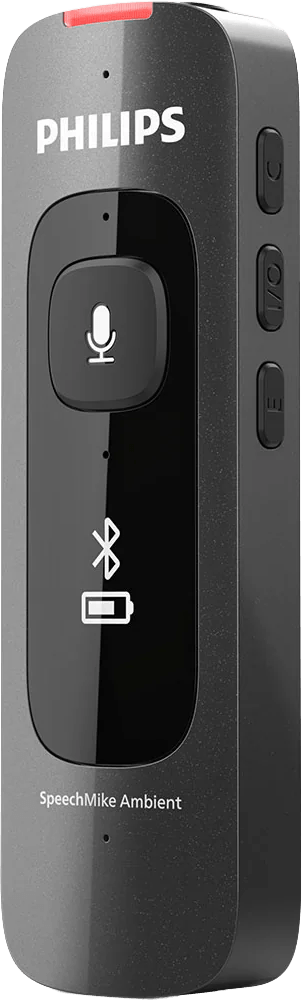
Professional-grade ambient capture
Built for real-world clinical environments, not casual consumer audio capture.
Single-speaker and multi-speaker workflows
Supports traditional dictation and doctor-patient conversation capture.
Beam-forming microphone technology
Philips describes the device as engineered with four high-performance beam-forming microphones.
AI speaker separation
Philips references AI speaker separation technology designed to support clearer multi-speaker capture.
Ambient scribe workflow fit
Designed for AI transcription, conversational AI, clinical note generation, and ambient scribe workflows.
Workflow flexibility
Relevant for exam room conversations, clinical note generation, hand-off notes, virtual assistant functions, and traditional dictation workflows.
Positioning line
Dragon Copilot powers the AI workflow. Philips SpeechMike Ambient improves the capture layer. eDist helps practices bring both together.
Why the microphone matters
The microphone is no longer an accessory. It is part of the AI documentation workflow.
In traditional dictation, the microphone captured one voice: the clinician speaking directly into Dragon. In ambient documentation, the microphone may need to capture natural conversation across the exam room.
If the AI misses a word, mishears a phrase, or loses speaker context, the provider may need to spend more time editing the final note.
Ambient capture may need to capture:
Software matters. The EHR workflow matters. The microphone matters too.
Better audio can reduce capture problems, but it cannot verify clinical meaning or eliminate the need for provider review.
- Test normal exam-room distance and movement.
- Include clinician, patient, and multi-speaker conversations.
- Evaluate room noise, device placement, and speaker overlap.
- Review the captured audio and the generated note as separate workflow layers.
Add CNEX for Dragon Copilot and eClinicalWorks
CNEX connector support for Dragon Copilot workflows.
For eClinicalWorks practices planning a Dragon Copilot rollout, eDist can help evaluate CNEX License Subscription as a connector option.
Important clarification
CNEX is for Dragon Copilot workflows, not Dragon Medical One workflows.
CNEX details
CNEX-supported EHR integration targets
CNEX is part of eDist's broader Dragon Copilot integration strategy for supported EHR environments, including:
CNEX is a Dragon Copilot connector consideration, not a Dragon Medical One add-on. Confirm current compatibility, availability, pricing, and implementation requirements before including it in the plan.
- Confirm the supported EHR, browser, extension, and configuration.
- Verify current licensing, marketplace availability, and subscription terms.
- Define how schedules, notes, and EHR synchronization should work.
- Include implementation, training, support, and ownership in the scope.
Pricing and value
Compare price, productivity, review burden, and upgrade path together.
A fast AI-generated note is not a productivity win if providers spend the same time correcting it. eDist helps practices compare licensing, renewal eligibility, CNEX cost, training, support, rollout needs, and provider time.
Eligible eClinicalWorks practices may be able to renew Dragon Medical One for as low as $79/user/month with a 3-year agreement.
CNEX License Subscription is planned at $85/user/month on a month-to-month term. CNEX pricing is separate from Dragon Medical One or Dragon Copilot licensing.
Value factors to compare
- Provider productivity risk
- Review and cleanup time
- Workflow disruption
- Training and support needs
- Device and room capture quality
- Long-term Microsoft AI roadmap fit
Pricing is subject to eligibility, term length, licensing model, region, partner path, and implementation requirements.
Subscription price is only one part of the decision. Compare the total cost of the documentation workflow.
- Licensing and renewal terms
- Provider review and correction time
- Training, implementation, and support
- Microphone, connector, and rollout requirements
Larger practices
Plan the Dragon path at practice scale.
Large eClinicalWorks practices need more than a feature comparison. They need a rollout strategy that protects provider adoption, standardizes support, and accounts for licensing, devices, training, and partner routing.
Workflow review
Compare existing DMO use, documentation gaps, eClinicalWorks workflows, and AI scribe review burden across providers and specialties.
Device strategy
Evaluate Philips SpeechMike Ambient, Dragon Copilot microphone needs, room environments, and multi-speaker capture requirements.
Support and routing
Use eDist's partner network for certified Dragon, Dragon Copilot, CNEX, and Dictation.cloud conversion paths.
Large practices should pilot the workflow before broad deployment and measure the operational impact, not only note-generation speed.
- Include representative providers and specialties in the pilot.
- Baseline and measure review, correction, and completion time.
- Standardize devices, training, escalation, and support.
- Define the Dragon Medical One continuity and Dragon Copilot migration plan.
Webinar
Bring your eCW documentation questions into one Dragon path discussion.
Use a webinar or guided review to compare Sunoh.ai, Dragon Medical One renewal options, Dragon Copilot planning, CNEX connector fit, and Philips SpeechMike Ambient capture planning before your practice commits to a switch.
Recommended agenda
- Where Sunoh.ai and Dragon differ
- How review burden affects productivity
- When DMO renewal makes sense
- How Dragon Copilot changes the upgrade path
- Where Philips Ambient and CNEX fit
Dragon licensees sold and supported by eDist through its North American network of certified Dragon specialists.
Why eDist
eDist gives eClinicalWorks customers a clear Dragon path forward.
eDist is a Microsoft-aligned healthcare platform company supporting more than 40,000 Dragon Medical One users. Through our North American network of certified Dragon specialists, eDist helps practices evaluate, renew, optimize, upgrade, integrate, train, and support Dragon documentation workflows.
FAQ
Questions eClinicalWorks practices should ask before switching.
Some eClinicalWorks customers are being encouraged to evaluate Sunoh.ai as an AI documentation option. That does not mean every practice should replace Dragon Medical One. Practices should compare their current Dragon workflow, provider review burden, DMO renewal options, Dragon Copilot planning, pricing, support, and CNEX connector fit before switching.
No. Sunoh.ai is an ambient AI medical scribe that creates draft documentation from patient-provider conversations. Dragon Medical One is a provider-directed speech documentation platform used for real-time dictation, correction, formatting, AutoText, custom vocabulary, voice commands, and documentation beyond the encounter note.
Sunoh.ai, like other AI-generated documentation tools, creates draft notes that must be reviewed by a qualified provider. Sunoh.ai's own safety guidance states that no AI program is perfect and that draft clinical notes must always be reviewed for accuracy and patient safety. Public user reviews also include concerns about errors, cleanup time, changed details, and diagnosis changes.
AI-generated clinical drafts may contain errors, omissions, misinterpretations, or content that requires provider correction. AI scribe risk guidance and ambient scribe research identify documentation inaccuracies, omissions, and variable note quality as category-level concerns.
AI-generated drafts can misinterpret temporal or clinical context, such as whether a condition is new, chronic, worsening, recurrent, or resolved. That is why every AI-generated clinical note must be reviewed before signing. For eClinicalWorks practices, the key question is how much manual review and correction will be required compared with provider-directed Dragon dictation.
Provider control matters because the final note becomes part of the medical record. If an AI-generated draft changes clinical context, misses an important detail, places information in the wrong section, or creates an inaccurate plan, the provider still has to identify and correct the issue before signing the note.
Because they are different workflow models. Sunoh.ai is scribe-first: it listens and drafts. Dragon Medical One is provider-directed: the clinician controls the note through real-time dictation, correction, formatting, AutoText, custom vocabulary, and commands. Practices should compare accuracy, review burden, workflow coverage, provider control, and long-term AI strategy.
For many Dragon Medical One users, Dragon Copilot may be the more natural AI upgrade path because it builds on familiar Dragon dictation workflows while adding ambient documentation, information surfacing, and workflow automation. Microsoft describes Dragon Copilot as an AI clinical assistant that streamlines documentation, surfaces information, and automates tasks.
Microsoft Learn states that Dragon Copilot version 3.2 extended dictation-at-the-cursor support to eClinicalWorks web-based EHRs when users upgrade to Dragon Copilot desktop version 3.2 and install the relevant web extension. Practices should still confirm compatibility based on region, configuration, browser, extension setup, workflow, and implementation requirements.
CNEX, or Clinical Note Exchange, is a Dragon Copilot connector layer. The Microsoft Marketplace listing describes Clinical Note Exchange as enhancing Microsoft Dragon Copilot with EHR integration, schedule retrieval, real-time ambient documentation, and syncing AI-generated documentation into the EHR.
No. CNEX is not for Dragon Medical One. CNEX is for Dragon Copilot workflows.
The CNEX License Subscription is planned at $85/user/month on a month-to-month term. CNEX pricing is separate from Dragon Medical One or Dragon Copilot licensing.
CNEX-supported integration targets include eClinicalWorks, athenaClinicals / athenaOne, athenaPractice, athenaFlow, NextGen Enterprise, Veradigm EHR, and ModMed / EMA.
eDist can still help compare workflows, provider adoption, documentation gaps, renewal options, Dragon Copilot planning, and whether Dragon Medical One or Dragon Copilot should remain part of your documentation strategy.
Depending on your location and needs, eDist may support your practice directly or route you to a certified Dragon Medical One, Dragon Copilot, or CNEX specialist through our U.S. and Canada partner network.
The best microphone depends on the provider's workflow, room environment, documentation style, and whether the practice needs single-speaker dictation, multi-speaker ambient capture, or both. eDist recommends evaluating professional-grade ambient capture devices, such as the Philips SpeechMike Ambient, for Dragon Copilot workflows, as ambient AI documentation depends on the quality of the captured conversation.
Philips SpeechMike Ambient is a wearable AI assistant and professional-grade microphone designed for ambient AI and speech recognition workflows. Philips describes it as supporting high-fidelity single-speaker and multi-speaker audio in real-world environments, including AI transcription, conversational AI, clinical note generation, and ambient scribe scenarios.
Ambient AI documentation depends on captured audio. If the microphone does not clearly capture the clinician, patient, or room conversation, the AI may have less reliable input to work from. A professional ambient microphone does not eliminate the need for provider review, but it can help improve the capture layer of the workflow.
Philips positions SpeechMike Ambient for ambient AI and speech recognition workflows, including clinical note generation and ambient scribe scenarios. eDist can help practices evaluate whether Philips SpeechMike Ambient is appropriate for their Dragon Copilot workflow, room environment, and provider preferences.
No. Philips positions SpeechMike Ambient for both ambient AI use cases and traditional speech recognition workflows. That makes it relevant for practices transitioning from provider-directed dictation toward Dragon Copilot and ambient AI.
No. A better microphone does not prevent every AI error, hallucination, omission, or clinical misinterpretation. However, better audio capture can help improve the quality of the input being processed. Practices should evaluate both the audio capture layer and the AI documentation workflow, then require provider review before signing clinical notes.
eDist has more than 50 years of experience selling, testing, deploying, and supporting professional input devices for dictation and documentation workflows. As ambient AI becomes part of clinical documentation, that expertise helps practices choose the right microphone, workflow, training model, and support path.
Before you lose control of your Dragon workflow, review the risk.
A fast AI-generated note is not a productivity win if correction time replaces dictation time. Before replacing Dragon Medical One with Sunoh.ai, compare workflow fit, provider review burden, clinical context, audio capture, renewal options, and the Dragon Copilot path.